Caves Uncovered: Exploring Their Varieties and How They Form


When most people think of caves, they imagine dark, underground chambers carved into rock, often filled with stalactites and stalagmites. However, the term “cave” encompasses a wide variety of naturally occurring structures formed through different geological processes.

These formations can vary significantly in size, shape, and origin, reflecting the diversity of environments in which they develop. Even among caves of the same type, there are notable variations influenced by local geology, climate, and the specific mechanisms driving their formation.

Caves are classified primarily by the processes responsible for their creation, including chemical dissolution, volcanic activity, mechanical erosion, and other natural forces. This classification reveals the complexity and variety of Earth’s subterranean landscapes, offering a fascinating glimpse into the planet’s dynamic geological processes.

What is a Cave?

A cave is broadly defined as a natural void in the Earth’s surface large enough for human entry. This seemingly straightforward definition, however, can vary depending on the region and the criteria used. While some definitions emphasize size, others focus on the geological processes that form the cave. These variations highlight the diversity of caves and the complexity of categorizing them.

Definitions of a Cave:

  • General Definition: A naturally occurring cavity or system of cavities in the Earth, large enough for a person to enter.
  • Regional Variations:
    • In Europe, definitions often include measurable dimensions, such as a minimum length or depth, to distinguish caves from small crevices or overhangs.
    • In North America, the definition is more inclusive, focusing on any naturally formed void, regardless of size, as long as it allows human access.
    • In some regions, even shallow recesses or rock shelters are classified as caves, especially when they hold cultural or archaeological significance.

These differing interpretations underscore the fact that not all caves are deep, dark, or extensive systems. The term “cave” encompasses a range of formations with unique characteristics.

Latest Posts

True Caves vs. Pseudo-Caves

Not all formations that resemble caves are classified as true caves. True caves are formed by geological processes such as chemical dissolution, volcanic activity, or mechanical erosion. In contrast, pseudo-caves are surface features that mimic the appearance of caves but do not meet the same criteria for origin or formation.

  • True Caves:
    • Formed through natural processes like the dissolution of rock, volcanic activity, or wave erosion.
    • Examples include limestone solution caves, lava tubes, and sea caves.
  • Pseudo- Caves:
    • Formed by external forces such as weathering or the accumulation of debris.
    • Examples include frost pockets, formed by freeze-thaw cycles, and spaces between boulders in talus slopes. While they resemble caves in appearance, their origins are distinct from those of true caves.

Variations Within Cave Types: Even within the same category, caves can vary significantly depending on the environment in which they form. For instance:

  • Solution caves: can develop in different types of soluble rock, such as limestone, dolomite, or gypsum, and can range from small isolated chambers to extensive networks stretching for hundreds of kilometers.
  • Lava tubes: may be smooth and tubular in basaltic flows but exhibit irregular shapes in regions with varied volcanic activity.
  • Sea caves: may form in soft sandstone or harder granite, resulting in vastly different appearances and sizes.

These variations arise from differences in the local geology, climate, and the duration and intensity of the forces shaping the cave.

Caves, in all their forms, reflect the incredible variety and adaptability of Earth’s geological processes. Whether formed by dissolution, volcanism, or mechanical erosion, each cave tells a story about the environment in which it was created.

Caves Formed by Chemical Processes

Caves formed through chemical processes, often called solution caves, are among the most common and extensive cave types worldwide. These caves are created when water interacts with certain types of rock, dissolving it over time and carving out voids and passageways. The primary mechanism behind their formation is the chemical reaction between slightly acidic water and soluble rocks, such as limestone, dolomite, and gypsum.


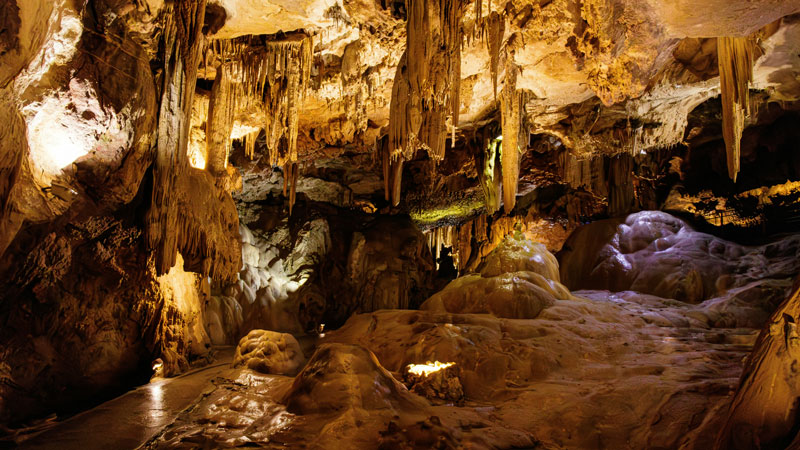
  • Grottes De Betharram, France

    Grottes De Betharram, France

    Grottes De Betharram, France

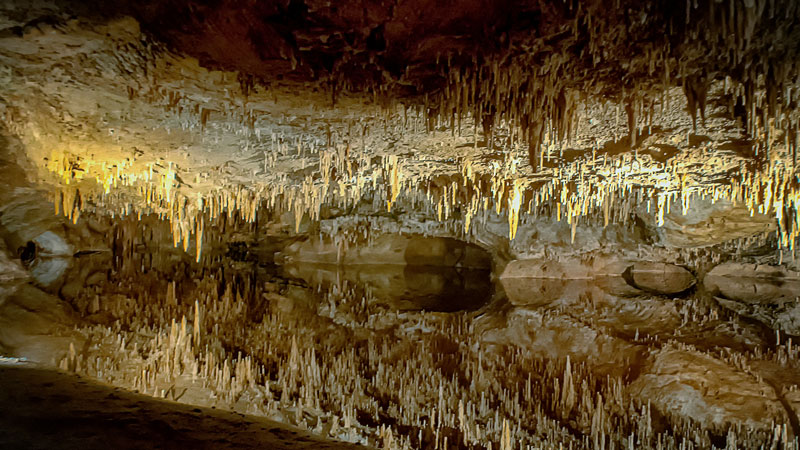
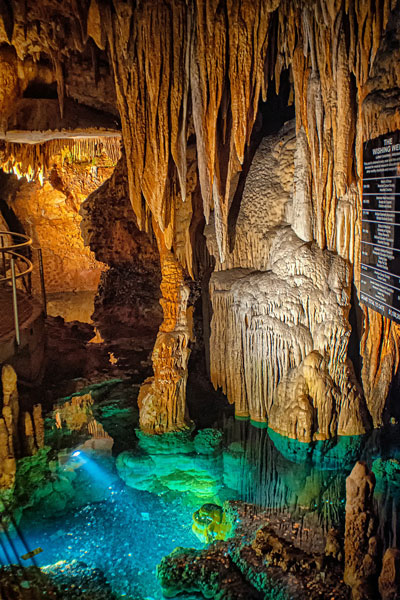
  • Luray Caverns, USA

    Luray Caverns, USA

    Luray Caverns, USA

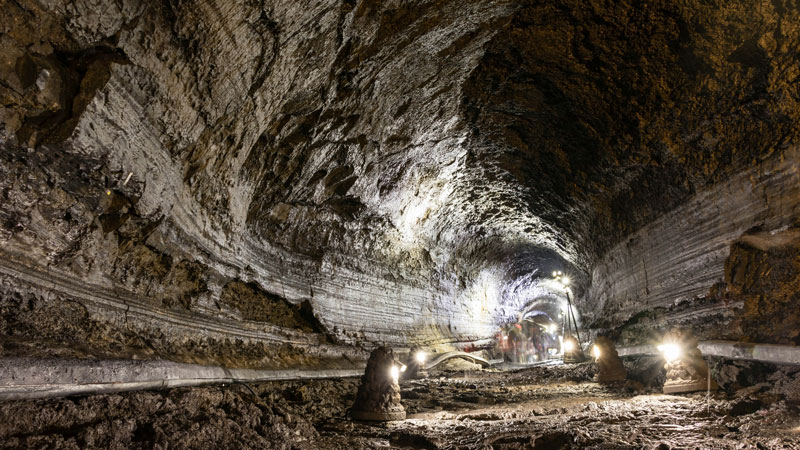
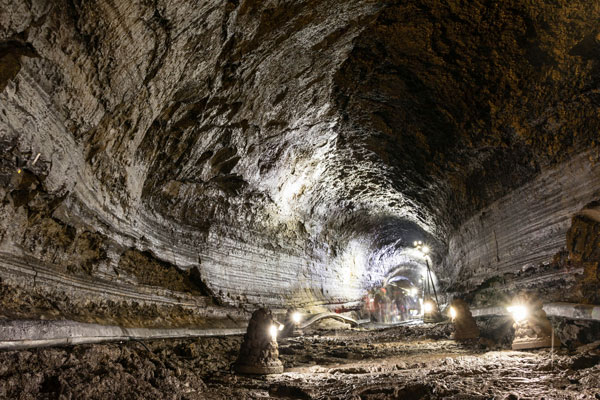
  • Manjanggul Cave, Jeju Si, South Korea

    Manjanggul Cave, Jeju Si, South Korea

    Manjanggul Cave, Jeju Si, South Korea

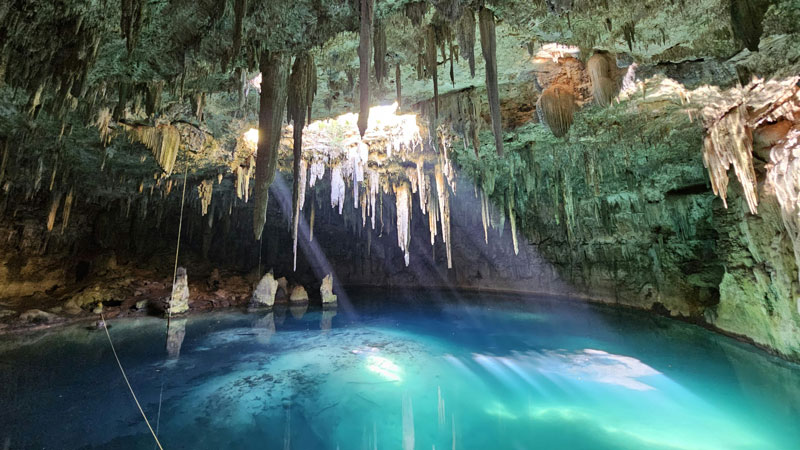
  • Cenote XCANAHALTUN, Temozon, Yucatan, Mexico

    Cenote XCANAHALTUN, Temozon, Yucatan, Mexico

    Cenote XCANAHALTUN, Temozon, Yucatan, Mexico

Formation of Solution Caves

  • 1. Epigenic Processes (Surface-Driven)
    • Rainwater absorbs carbon dioxide (CO₂) from the atmosphere and soil, forming weak carbonic acid.
    • This acidic water percolates through cracks in the rock, gradually dissolving calcium carbonate (the primary component of limestone).
    • Over thousands to millions of years, the dissolution enlarges these cracks into voids, which can eventually develop into extensive cave systems.
    • Examples of features formed by this process include underground rivers, sinkholes, and interconnected passages.
    • This is the process in which Rat's Nest Cave was formed!
  • 2. Hypogenic Processes (Subsurface-Driven)
    • In some cases, caves form deep below the surface when water rich in hydrogen sulfide (H₂S) rises from deeper rock layers.
    • This water reacts with oxygen to form sulfuric acid, which is much stronger than carbonic acid.
    • The sulfuric acid aggressively dissolves rock from below, creating large chambers and unusual formations.
    • A well-known example of this process is Carlsbad Caverns in New Mexico, USA.

Variants of Solution Caves

  • Cenotes:
    • Sinkholes filled with water that form when the roof of a limestone cave collapses.
    • Common in regions with extensive limestone bedrock, such as the Yucatán Peninsula in Mexico.
    • Often connected to underwater cave systems and are culturally significant to the Maya civilization.
  • Gypsum Caves:
    • Formed in areas where gypsum, a highly soluble mineral, is present.
    • Tend to develop unique formations due to the softer nature of the rock.

Features of Solution Caves

Solution caves are characterized by a wide variety of formations, or speleothems, which develop as dissolved minerals are redeposited by dripping or flowing water:

  • Stalactites: Icicle-like formations hanging from the ceiling.
  • Stalagmites: Pillar-like formations growing upward from the floor.
  • Flowstones: Sheet-like deposits created by water flowing over walls or floors.
  • Columns: Formed when stalactites and stalagmites meet.

These features add to the visual and geological complexity of solution caves, making them some of the most studied and visited cave types.

Interesting Facts

  • Solution caves can take millions of years to form but may grow more rapidly in regions with high rainfall or active tectonic uplift.
  • The world’s largest known cave, Son Doong in Vietnam, is a solution cave formed in limestone. Its main chamber is so vast that it contains its own weather system.
  • Many prehistoric human artifacts and fossils have been discovered in solution caves, highlighting their importance as shelters and sites of human activity.

Chemical processes have shaped some of the most intricate and awe-inspiring caves on Earth.

Son Doong: The World's Largest Cave

Hidden in the dense jungles of Phong Nha-Ke Bang National Park in central Vietnam lies Son Doong Cave, a geological marvel and the largest known cave in the world. Discovered relatively recently, in 1991 by a local farmer and officially explored in 2009, this colossal cave has captured global attention for its extraordinary size, unique ecosystem, and breathtaking formations. Translating to “Mountain River Cave” in Vietnamese, Son Doong is not just a natural wonder but also a testament to the incredible forces of geology.

Son Doong was formed roughly 2-5 million years ago through the dissolution of limestone, a process common to solution caves. An underground river gradually carved through the soft rock, creating vast chambers. In some places, the cave’s ceiling collapsed, forming large skylights that allow sunlight to penetrate the darkness.

The cave remained hidden for millions of years, unknown even to the local population. It wasn’t until 1991 that a local farmer, Ho Khanh, stumbled upon its entrance while seeking shelter from a storm. The sound of wind whistling through the massive opening and the sight of a dense mist intrigued him, but it wasn’t until 2009 that the British Cave Research Association, led by Howard Limbert, conducted a formal expedition to map and explore Son Doong.

Son Doong is not just notable for its size; its ecosystem and formations are equally remarkable. The cave houses a thriving, self-contained environment with lush vegetation growing near the skylights. This “jungle within a cave” includes towering trees, moss, and ferns. Animal life, such as flying foxes and cave-dwelling insects, has adapted to the unique conditions of this subterranean world.

In addition to its ecosystem, Son Doong is home to breathtaking formations, including some of the world’s largest stalagmites, which rise up to 70 meters (230 feet) tall. Enormous cave pearls—formed by the gradual deposition of calcium carbonate around grains of sand—litter the cave floor. The underground river that helped carve the cave still flows, adding to its dynamic landscape.

Son Doong is a treasure not only for geologists and adventurers but also for Vietnam’s tourism industry. Strict regulations are in place to limit the number of visitors and ensure the cave’s pristine condition is preserved. Access to the cave is managed through guided tours, which are both physically demanding and environmentally conscious.

Son Doong stands as a symbol of the Earth’s untamed beauty, offering a glimpse into a hidden world shaped by natural forces over millions of years. Its discovery and exploration have deepened our understanding of caves and the ecosystems they harbor, cementing its place as one of the planet’s most awe-inspiring natural wonders.
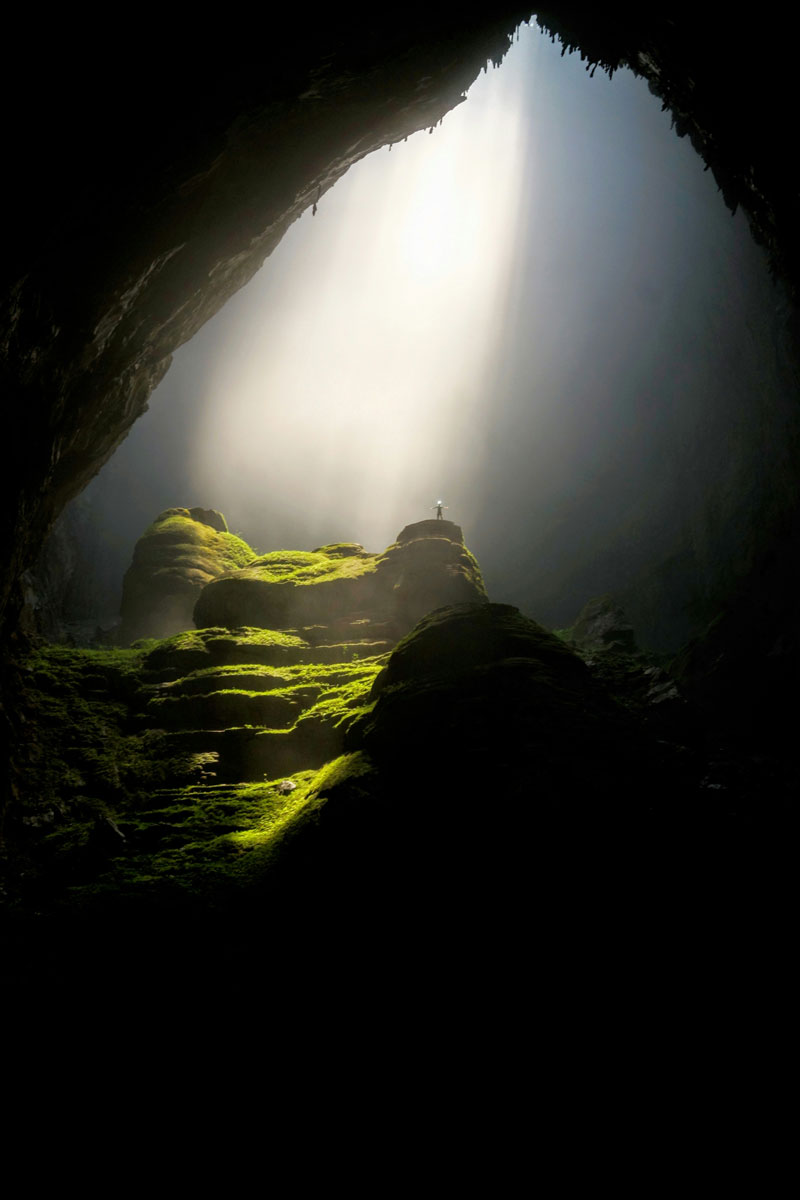
Son Doong’s dimensions are staggering, with its largest chamber stretching over 5 kilometers (3.1 miles) in length, 200 meters (656 feet) in height, and 150 meters (492 feet) in width. This means that it could comfortably fit an entire New York City block, complete with skyscrapers, inside its cavernous interior. Its volume is so vast that it has its own localized weather system, with clouds and mist forming due to temperature and humidity differences between the cave and the outside environment. Son Doong is approximately twice the size of its closest rival, Deer Cave in Malaysia, making it the undisputed giant of the underground world.

Caves Formed by Volcanism

Caves formed by volcanism, most notably lava tubes, are created during volcanic eruptions when molten lava flows and cools in specific ways. These caves are significantly different from those formed by chemical or mechanical processes, both in their formation mechanisms and their unique characteristics. Unlike many other cave types that take millennia to develop, lava tubes can form rapidly, sometimes in just days or weeks.

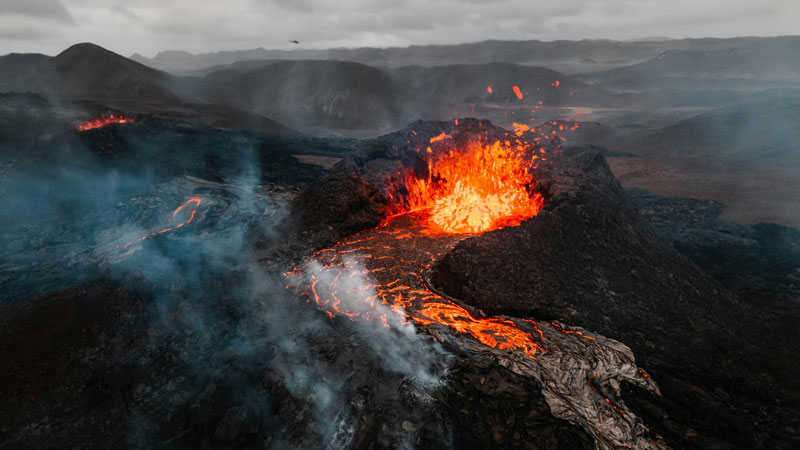
  • Volcano Erupting In Iceland With Lava Flowing

    Volcano Erupting In Iceland With Lava Flowing

    Volcano Erupting In Iceland

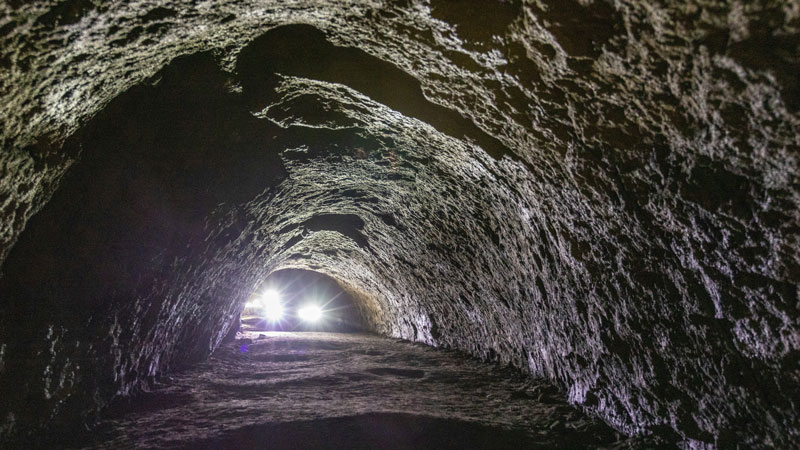
  • Lava River Cave Bend Oregon

    Lava River Cave Bend Oregon

    Lava River Cave Bend Oregon

Formation of Lava Tubes

Lava tubes form during the eruption of basaltic lava, which is low in viscosity and can flow long distances before solidifying. The process unfolds in two key stages:

  • 1. Surface Cooling
    • As lava flows downhill, its surface begins to cool and solidify upon exposure to the air. This creates a solid crust that insulates the molten lava beneath, allowing it to remain fluid.
  • 2. Lava Drainage
    • Once the eruption subsides or the lava supply decreases, the molten lava drains out of the tube, leaving a hollow conduit. These tubes can extend for many kilometers, depending on the eruption’s duration and the lava’s properties.

Examples and Global Distribution

Lava tubes are most common in regions with basaltic volcanism. They are found in volcanic landscapes worldwide, with notable examples including:

  • Hawaii: The Hawaiian Islands, particularly the Big Island, are home to some of the most extensive and well-preserved lava tubes.
  • Iceland: Known for its basaltic terrain, Iceland features numerous lava tubes accessible for exploration.
  • Pacific Northwest, USA: Lava tubes can be found in volcanic areas such as Oregon and Washington, formed during ancient eruptions.

Features of Lava Tubes

Lava tubes are distinct from other cave types due to their smooth, rounded structures and specific volcanic features:

  • Smooth or Rippled Walls: The flowing lava leaves behind smooth walls, often marked by ripples or ridges.
  • Ropey Lava (Pāhoehoe Texture):Common in regions with extensive limestone bedrock, such as the Yucatán Peninsula in Mexico.
  • Skylights:Portions of the tube’s roof may collapse, creating openings to the surface. These skylights provide natural access points and allow light to penetrate the otherwise dark caves.
  • Multi-Level Structures:In some cases, lava tubes form on multiple levels as subsequent lava flows carve new conduits above or below older ones.

Importance of Lava Tubes

Lava tubes are valuable not only for their geological significance but also for their potential applications and ecological importance:

  • Geological Insights: Lava tubes provide a record of volcanic activity, helping scientists understand eruption patterns and predict future events.
  • Ecosystems: Some lava tubes host unique ecosystems, with species adapted to the stable temperatures and complete darkness of these environments.
  • Space Exploration: Similar structures have been identified on the Moon and Mars. Studying Earth’s lava tubes helps scientists explore their potential as habitats for future space missions.

Interesting Facts

  • The longest known lava tube is Kazumura Cave in Hawaii, which stretches over 65 kilometers (40 miles).
  • Lava tubes can remain geothermally active long after their formation, creating warm, steamy conditions in some areas.
  • Many lava tubes have historical significance, serving as shelters, burial sites, or ceremonial spaces for ancient peoples.

Caves formed by volcanism are a testament to the dynamic forces shaping Earth’s surface. Their rapid formation, unique features, and scientific importance make lava tubes a fascinating subject of study and a key part of the diverse world of caves.

Caves Formed by Mechanical Processes

Caves formed by mechanical processes result from physical forces acting on rock and sediment. Unlike chemical or volcanic caves, these caves are created when rock is eroded, broken, or displaced without any significant chemical alteration. Mechanical caves include a variety of types, such as sea caves, talus caves, tectonic caves, eolian caves, and frost pockets, each shaped by different forces and environmental conditions.

Sea Caves (Littoral Caves):

Sea caves form along coastlines, where wave action erodes rock over time. These caves are most common in cliffs made of softer or fractured rock types, which are more vulnerable to the relentless pounding of waves.

  • Formation: Waves exploit weaknesses in the rock, such as cracks or faults, gradually enlarging them into voids. Over time, these voids expand into chambers or tunnel-like passages.
  • Characteristics:
    • Often found near sea level and shaped by tides.
    • Can feature smooth walls or jagged edges, depending on the rock type.
  • Interesting Fact: Sea caves are often temporary structures, as ongoing erosion can eventually cause them to collapse.
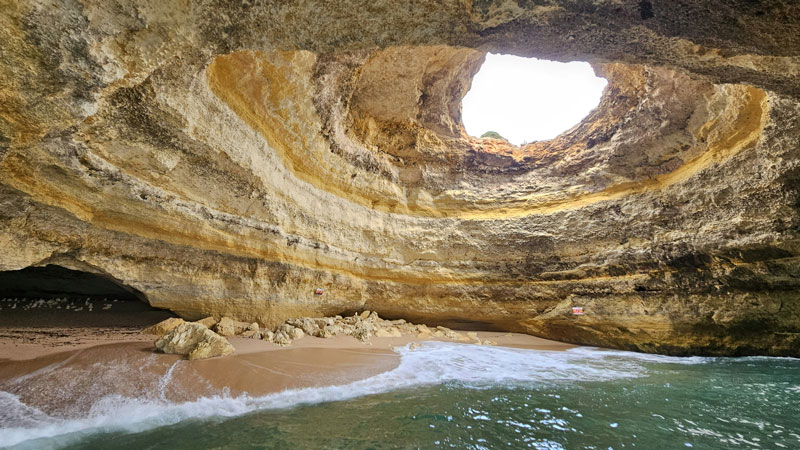
  • A Sea Cave

  • Benagil Sea Cave, Lagoa, Portugal

    Benagil Sea Cave, Lagoa, Portugal

    Benagil Sea Cave, Lagoa, Portugal

Glacier Caves:

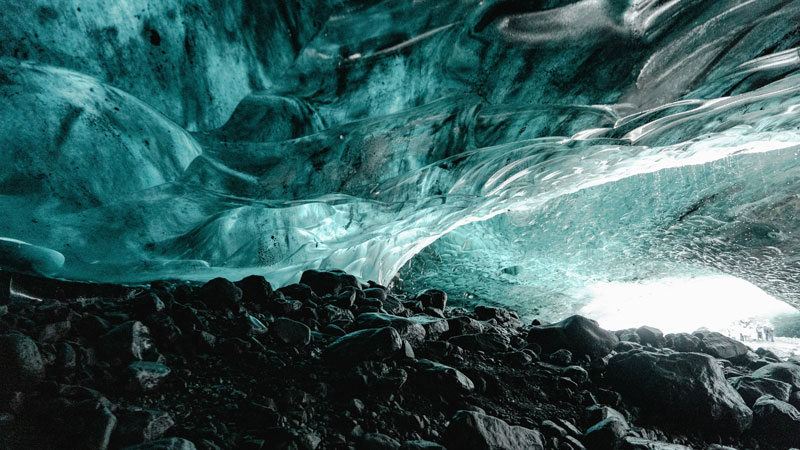
Glacier caves, often referred to as ice caves, are naturally occurring voids that form within glaciers or permanent ice fields. These caves are dynamic and constantly changing due to the movement and melting of the ice.

  • Formation: Glacier caves are typically formed by meltwater streams running through or beneath a glacier. The water gradually carves out tunnels and chambers as it flows, aided by the heat from the surrounding environment. In some cases, geothermal heat or volcanic activity beneath a glacier can accelerate the melting process, forming what are known as **glacio-volcanic caves**.
  • Characteristics:
    • Highly dynamic, with structures that can change seasonally or even daily.
    • Often feature stunning blue ice walls, caused by the compaction of ice filtering out all but blue light.
    • Typically found in polar or high-altitude regions, or near volcanic activity.
  • Interesting Fact: Glacio-volcanic caves, such as those formed on glaciers atop Icelandic volcanoes, offer a rare combination of ice and geothermal features, making them unique geological environments.
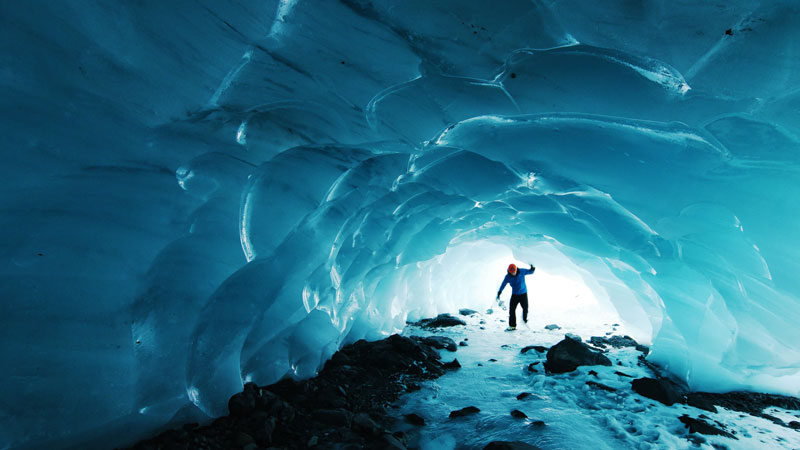
  • Byron Glacier Cave, Chugach National Forest, Seward, United States

    Byron Glacier Cave, Chugach National Forest, Seward, United States

    Byron Glacier Cave, Chugach National Forest, Seward, United States

  • Glacier Cave, Jokulsarlon, Iceland

    Glacier Cave, Jokulsarlon, Iceland

    Glacier Cave, Jokulsarlon, Iceland

Talus Caves:

Talus caves form when large boulders or rock fragments accumulate on slopes, creating spaces and voids between them. These caves are common in areas with steep cliffs or mountains where rockfalls occur.

  • Formation: As rocks fall and pile up, they leave behind interconnected gaps that create a network of small passages.
  • Characteristics:
    • Typically irregular in shape and limited in size.
    • Less extensive than other cave types, but often accessible and stable.
  • Interesting Fact: Talus caves often serve as habitats for wildlife, such as bats and small mammals, and were occasionally used as shelters by early humans.

Tectonic (Fracture) Caves:

Tectonic caves form due to the movement of Earth’s crust, creating voids along faults or fractures. Unlike other caves, these are not carved or eroded but result from shifts in rock layers.

  • Formation:Movements such as earthquakes or gradual tectonic activity cause large sections of rock to separate, leaving open spaces.
  • Characteristics:
    • Irregular and jagged passages.
    • Found in seismically active regions or areas with significant crustal stress.
  • Interesting Fact: These caves are often associated with geologic features like fault lines or escarpments.

Eolian Caves:

Eolian caves are formed by wind erosion in arid environments. Over time, windblown sand or dust scours away softer rock, creating cavities and voids.

  • Formation: Wind carries abrasive particles that grind away at rock surfaces, particularly in soft sandstone or other porous materials.
  • Characteristics:
    • Often found in desert regions.
    • Typically smaller and less extensive but visually striking, with smooth, sculpted walls.
  • Interesting Fact: Eolian caves are not only geological features but also indicators of past wind patterns and environmental conditions.

Frost Pockets (Pseudo-Caves):

Frost pockets are a type of pseudo-cave created by freeze-thaw cycles. While not true caves, they resemble caves in appearance and are often found in cold climates.

  • Formation:Water seeps into cracks in rock, freezes, and expands, breaking the rock apart. Over time, this process creates cavities or enlarges existing ones.
  • Characteristics:
    • Typically small and irregular.
    • Found in regions with significant seasonal temperature fluctuations.
  • Interesting Fact: Frost pockets provide valuable evidence of historical climate conditions and freeze-thaw processes.

Mechanical caves demonstrate the power of physical forces in shaping Earth’s surface. While they may not be as vast or intricate as caves formed by chemical or volcanic processes, they reveal the dynamic interactions between geology and the environment. These caves, whether carved by waves, wind, or tectonic activity, add to the diverse tapestry of Earth’s underground landscapes.

Caves are a testament to the dynamic forces shaping our planet. From the slow dissolution of rock by chemical processes to the rapid creation of lava tubes during volcanic eruptions, and the physical sculpting by waves, wind, and tectonic movements, each type of cave offers a unique insight into Earth’s geology. Even within a single category, the variations in size, shape, and formation mechanisms highlight the complexity and diversity of these natural structures

Understanding how caves form helps us appreciate their role in Earth’s history and ecosystems. Whether carved by water, forged by fire, or shaped by physical forces, caves are more than just underground voids—they are records of geological time, habitats for unique species, and natural wonders that inspire curiosity and exploration.
Rat's Nest Cave: A 300-Million-Year Story Beneath Grotto Mountain


Rat's Nest Cave sits beneath Grotto Mountain on the edge of Canmore, Alberta — less than 20 minutes from Banff and at the gateway to Kananaskis Country in the Canadian Rockies' Bow Valley. It is one of the most scientifically significant caves in Canada, and one of the very few natural cave systems in the country designated a Provincial Historic Resource under Alberta's Historical Resources Act. Its passages encode the deep history of a continent: ancient tropical oceans, the grinding advance and retreat of ice ages, a bone-filled pit spanning thousands of years of wildlife history, and the presence of indigenous peoples long before European explorers set foot in the Rockies. This is not a cave that simply exists. It is a cave that remembers.

Geology of Rat's Nest Cave: Origins 360 Million Years Ago

The story of Rat's Nest Cave begins not in Alberta, but in a warm, shallow ocean sitting just north of the equator. Around 360 million years ago, during the Devonian and early Carboniferous periods, the landmass that would eventually become western Canada lay beneath a tropical sea — part of the vast Panthalassan Ocean bordering the supercontinent of Laurasia. Coral reefs thrived here, populated by crinoids (sometimes called sea lilies, though they are animals, not plants), brachiopods, and a rich assortment of marine life.

Over millions of years, the remains of these organisms accumulated on the seafloor, compressing under their own weight into the thick limestone layers known today as the Livingstone and Mount Head formations. These are the same imposing cliffs you see towering over the town of Canmore. They are, quite literally, an ancient seabed lifted skyward.

The plate tectonics that followed were titanic in scale. Continental collisions eventually assembled the supercontinent of Pangaea, which then began to fracture around 200 million years ago. As the Atlantic Ocean opened and North America drifted northwest, the continent's western edge crumpled against volcanic island chains rising from the Pacific floor. The result — playing out over tens of millions of years — was the Canadian Rocky Mountains. The compression created deep faults in the limestone, lines of weakness that would, in time, become the pathways for water. Those pathways would eventually become Rat's Nest Cave.

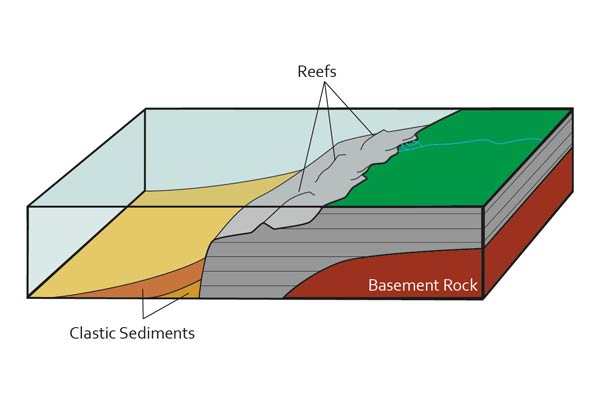
  • Diagram of Devonian carbonate reef formation showing basement rock, clastic sediments, and reef structures — the geological origin of Rat's Nest Cave limestone, Canmore Alberta
    Carbonate Reefs

    Carbonate reef systems of the type that formed the limestone now hosting Rat's Nest Cave. Tropical reef structures built up over millions of years during the Devonian and early Carboniferous periods, their remains eventually compressed into the thick limestone formations visible in the cliffs above Canmore today.

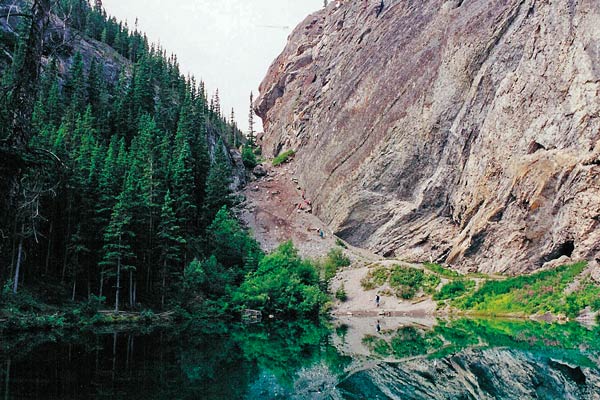
  • Ancient Devonian reef structures in limestone cliffs above Grassi Lakes, Canmore Alberta — the same rock formation containing Rat's Nest Cave
    Grassi Lakes reef

    Ancient reef structures exposed in the limestone cliffs above Grassi Lakes, Canmore. These formations are part of the same Rundle Group limestone in which Rat's Nest Cave developed — a tropical seabed, now lifted thousands of metres above sea level by the building of the Canadian Rocky Mountains.

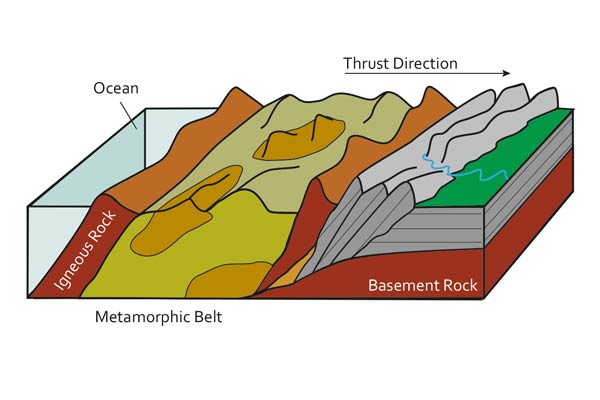
  • Diagram of thrust fault mountain building in the Canadian Rockies showing thrust direction, metamorphic belt, and basement rock — the geological process that created the fault system of Rat's Nest Cave, Grotto Mountain, Canmore Alberta
    Building the Rocky Mountains

    The thrust faulting that built the Canadian Rocky Mountains created the fracture system along which Rat's Nest Cave eventually formed. As continental collision pushed slabs of limestone northeastward over younger rock, deep lines of weakness opened in the bedrock — pathways that groundwater would spend millions of years quietly enlarging into cave passages.

Latest Posts

How Rat's Nest Cave Formed: Faults, Water, and Ice

Cave formation is a slow, patient process. Slightly acidic groundwater — rainwater and snowmelt charged with carbon dioxide absorbed from the atmosphere and soil — percolates down through the rock, attacking the calcium carbonate in the limestone and dissolving it molecule by molecule. Given enough time and the right structural conditions, this quiet chemistry widens fractures into passages, passages into chambers.

For Rat's Nest Cave, the critical structural feature was a thrust fault — a very low-angled fracture running through the Grotto Mountain limestone, formed during the final phases of mountain building around 45 to 85 million years ago. Water found this fault and began to work. For tens of millions of years, the cave grew slowly beneath the water table, the passages forming in the classic rounded, tube-like shapes characteristic of phreatic (water-filled) conditions. Scalloping patterns still visible at the cave entrance record the turbulent flow of water that once rushed through.

Then came the ice ages. Beginning around 1.6 million years ago, repeated glaciations dramatically altered the landscape of the Bow Valley. Glaciers advancing down the valley deepened and widened it, changing the course of rivers, dropping the water table, and dramatically accelerating the evolution of the cave. As the water table fell, the cave drained and shifted from phreatic to vadose (air-filled) conditions — the phase in which the mineral formations we associate with caves begin to grow. Glacial meltwaters flushed sediments into the passages. Ice plugs formed in the deeper reaches. The cave became a dynamic, shifting archive of the climate itself.

Today, the cave extends more than 4 kilometres into the mountain — a three-dimensional maze of passages, chambers, tubes, and shafts, all formed along that original fault system. The entrance sits at approximately 1,800 metres elevation, and the cave descends to around 1,500 metres. It maintains a near-constant temperature of 4.5°C year-round, and because it never freezes, it has served for thousands of years as a refuge for insects, bats, rodents, and — as we will see — much more.

Wait... the cave is always 4.5°C? Find out why...

Speleothems and Climate Science: Rat's Nest Cave's 766,000-Year Record

Among the most scientifically compelling aspects of Rat's Nest Cave are its mineral formations — the stalactites, stalagmites, flowstone, curtains, and soda straws that have been building, dissolving, and rebuilding for hundreds of thousands of years. These formations, collectively called speleothems, are not merely beautiful. They are precise natural archives of the climate.

Speleothems form when groundwater seeping through the limestone bedrock loses carbon dioxide upon entering the open cave air, causing dissolved calcium carbonate to precipitate as calcite. They grow in layers — sometimes thickly during warm, wet interglacial periods; barely at all, or not at all, during glaciations when the ground above freezes and the supply of seeping water shuts down. These growth interruptions are as informative as the growth itself.

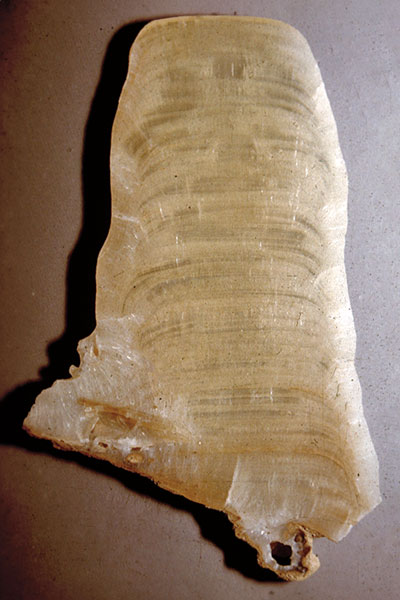
Using uranium-series dating — a radiometric technique that measures the ratio of uranium isotopes to their radioactive decay products, thorium and protactinium — researchers have been able to date speleothems from Rat's Nest Cave to ages ranging from 3,800 years to approximately 766,000 years before present. This range is among the most complete Quaternary records documented from any cave in Canada, placing Rat's Nest Cave in rare scientific company. One stalactite, catalogued as 881010, records at least five distinct phases of growth separated by glacial flood events — each inundation leaving a mud coating, each interglacial period leaving new calcite layers. Its cross-section reads like a stratigraphic column of the Pleistocene.

The speleothems also contain trace amounts of organic acids that exhibit a phenomenon known as luminescence — they glow faintly when exposed to ultraviolet light. Remarkably, the intensity of this luminescence correlates with past solar activity, and instruments sensitive enough to detect annual variation in the sun's output have been used to study samples from this cave. Work by researcher Yavor Shopov demonstrated that single-year solar cycles could be resolved within individual growth layers — so-called Shopov Bands — a level of resolution that transformed speleothem climate research internationally. The cave's record has since been incorporated into continental-scale climate studies alongside sites in Europe and North America.

What does this record tell us? In broad terms, the cave's speleothem history confirms the pattern of glacial and interglacial cycles seen in deep-sea sediment cores and Antarctic ice cores. But it provides a uniquely regional perspective — anchored in the Bow Valley — that contributes something no other archive can: a local signal from the heart of the Canadian Rockies, spanning nearly three-quarters of a million years.

Want to learn more about speleothems? Check out this article.

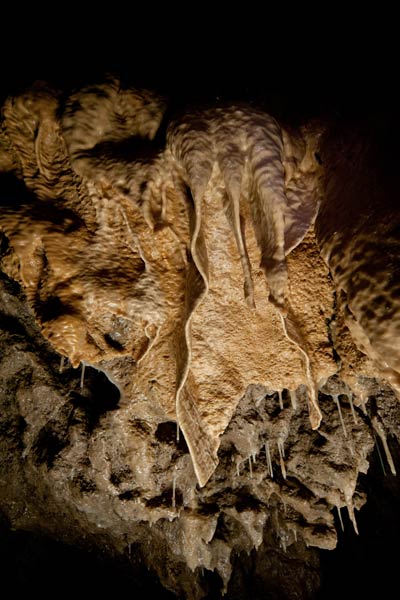
  • Calcite drapery speleothems inside Rat's Nest Cave, Canmore Alberta — banded cave formations showing thousands of years of mineral deposits in the Canadian Rockies
    Draperies

    Calcite draperies in Rat's Nest Cave, their banded "streaky bacon" colouring the result of trace organics and minerals carried by seeping groundwater over thousands of years. Each layer records a slightly different chemical environment at the time of deposition — a visible archive of conditions at the surface far above.

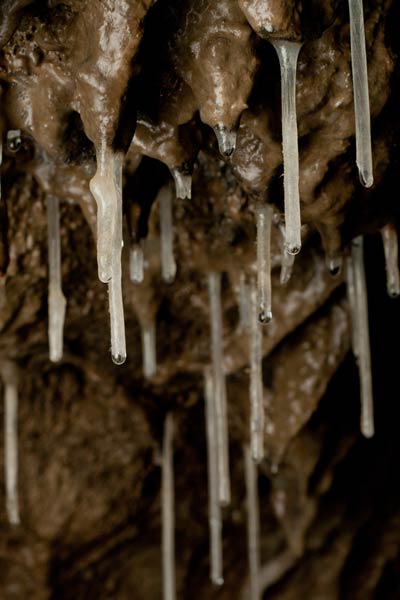
  • Soda straw stalactites in Rat's Nest Cave, Canmore Alberta — fragile hollow calcite speleothems growing at approximately 30cm per 2000 years in the Canadian Rockies cave system
    Soda Straws

    Soda straw stalactites hanging from the ceiling of Rat's Nest Cave. These hollow tubular formations grow as water travels down through a central channel, depositing a thin ring of calcite at the tip with each drop. Research at the cave has determined that soda straws here grow approximately 30 centimetres over 2,000 years — making even the smallest formation a significant piece of natural history.

  • Cross-section of a stalagmite from Rat's Nest Cave showing growth layers and glacial interruptions — uranium-series dated climate record spanning 766000 years, Canmore Alberta
    Stalagmite Cross-Section

    A cross-section through a stalactite from Rat's Nest Cave, revealing distinct growth layers laid down over hundreds of thousands of years. Gaps in the banding record glacial periods when permafrost shut down the supply of seeping groundwater entirely. Using uranium-series dating, researchers have read formations like this one as a climate record extending back nearly 766,000 years — among the most complete Quaternary archives from any cave in Canada.

  • The Grotto chamber inside Rat's Nest Cave, Canmore Alberta — densely decorated with stalactites, stalagmites, flowstone and curtain speleothems in the Canadian Rockies cave system
    The Grotto

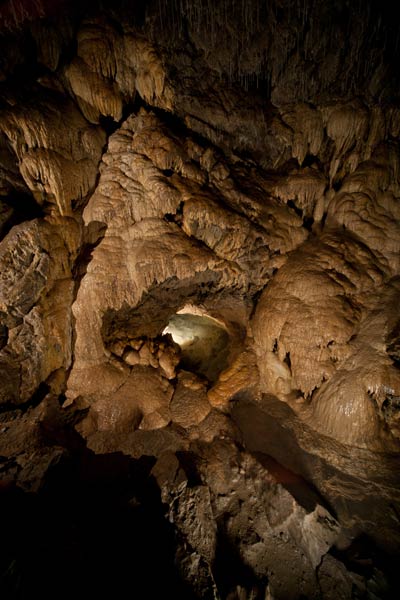
    The Grotto, one of the most heavily decorated chambers in Rat's Nest Cave. Multiple water sources converge here, producing an exceptionally dense concentration of speleothems — stalactites, stalagmites, flowstone, curtains, and soda straws forming in a space where dripping, flowing, seeping, and pooled water have all left their mineral signatures. The Grotto is also the site of the cave's flooded siphon, first dived in 1979.

The Bone Bed: Rat's Nest Cave's Paleontological Record

Near the cave entrance, a 15-metre shaft drops into the mountain. At the base of this pit lies one of the most remarkable paleontological sites in Alberta: the Bone Bed, a two-metre-thick stratigraphic sequence of frost-shattered rock, soil, and bones — thousands of them, accumulated over at least 3,000 years.

The pit is a natural trap. Animals that wandered too close to the entrance — or were deliberately disposed of there by human visitors — fell in and did not get out. Over millennia, layers built up. Palaeontologist Dr. James Burns of the Royal Alberta Museum conducted a preliminary assessment of the assemblage in 1986, and the species list he documented reads like a census of the Holocene Rockies: Canadian gray wolf, black bear, lynx, wolverine, pine marten, coyote, swift fox, badger, mink, bighorn sheep, pika, and numerous rodent and bird species including golden eagle, passenger pigeon, and crow.

One particular specimen — a gray wolf jawbone extracted from roughly halfway down the sequence — was assessed at approximately 3,000 years old. The full depth of the deposit may extend the record considerably further back. Each layer is a snapshot of the animal community that inhabited the Bow Valley at a given moment, and the sequence as a whole captures the post-glacial reestablishment of wildlife in the region following the retreat of the last great ice sheet around 11,000 years ago.

The Bone Bed does not only contain wildlife remains. Human activity is encoded there too — worked animal bones, tool fragments, and other cultural material associated with the indigenous peoples who used the site. An osprey that apparently flew into the cave carrying a fish from the Bow River left behind a complete fish skeleton. Layers of fossil rodent middens interleave with the larger bones. The pit has been described as potentially the best-documented mid- to late-Holocene environmental record anywhere in Alberta — a distinction that underscores both its scientific value and the importance of preserving what remains of it undisturbed.

  • Researcher examining animal skulls and bones at the Bone Bed in Rat's Nest Cave, Canmore Alberta — a 7000-year paleontological record containing 34 mammal species from the Canadian Rockies
    Bone Bed Bones

    Skulls and bones spilling from the base of the Bone Bed pit into the horizontal passage beyond. The assemblage — accumulated over at least 7,000 years at the base of the cave's 15-metre entrance shaft — includes the remains of 34 mammal species, making it one of the most significant Holocene vertebrate fossil sites in Alberta.

  • Paleontologist excavating the Bone Bed deposit inside Rat's Nest Cave, Canmore Alberta — stratigraphic record of Bow Valley wildlife spanning 7000 years in the Canadian Rockies
    Bone Bed Excavation

    Paleontological excavation of the Bone Bed at Rat's Nest Cave. The two-metre-thick deposit of frost-shattered rock, soil, and bones represents a continuous stratigraphic record of wildlife in the Bow Valley spanning thousands of years — layer by layer, a census of the animals that inhabited this landscape from the end of the last ice age onward.

  • Large mammal skull recovered from the Bone Bed at Rat's Nest Cave, Canmore Alberta — paleontological specimen from a 7000-year fossil deposit in the Canadian Rockies
    Bone Bed Skull

    A large mammal skull recovered from the Bone Bed, one of hundreds of specimens documented by Dr. James Burns of the Provincial Museum of Alberta. The deposit contains remains of species no longer present in the Bow Valley, including the gray wolf, wolverine, and swift fox — animals whose presence here speaks to a wilder, less fragmented landscape than exists today.

  • Cross-section diagram of Rat's Nest Cave entrance shaft showing Bone Bed location and depth, with inset of Pelican Lake culture projectile point recovered from the cave, Canmore Alberta
    Bone Bed Cross Section

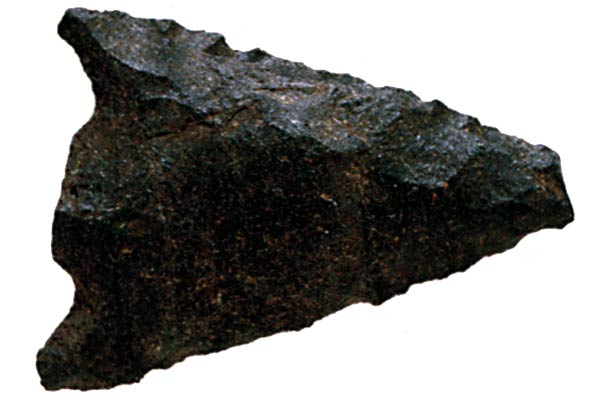
    Cross-section of the Rat's Nest Cave entrance shaft showing the location and extent of the Bone Bed deposit, with bone-bearing layers extending more than 7,000 years into the past. Inset: a Pelican Lake style projectile point recovered from the cave, one of only two prehistoric stone tools found at the site, dated to approximately 1350 BC–100 AD and likely made from obsidian originating in Oregon or Washington.


Indigenous History at Rat's Nest Cave: The Pelican Lake People

People have known about Rat's Nest Cave for a very long time. Archaeological evidence indicates that humans have occupied the Bow Valley region continuously from at least 10,500 years before present, with the possibility — suggested by finds at the Vermilion Lakes site near Banff — of much earlier presence during warmer interludes of the mid-Wisconsin glaciation, 60,000 to 25,000 years ago.

The cultural group most directly associated with the cave is the Pelican Lake people, who occupied the Alberta Plains and foothills roughly 3,000 to 3,500 years ago. They are sometimes called the 'Renaissance People of the Plains' for the sophistication of their culture and trade networks — their tools include obsidian projectile points whose stone originated in sources far to the south and west, indicating long-distance exchange relationships reaching across the continent.

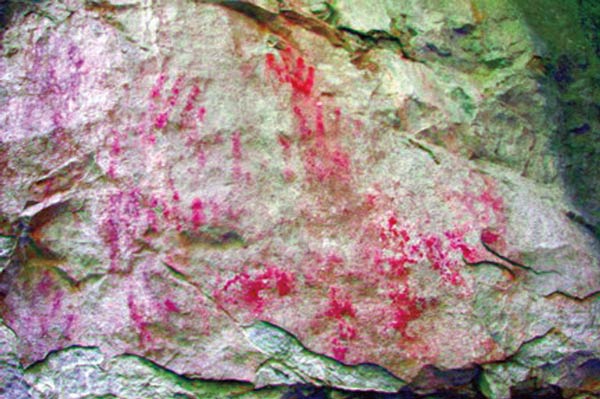
Material recovered from the Bone Bed pit — including worked bone, prepared deer hides, and tool fragments — suggests that the cave was a functional site: a place where meat was processed and stored, waste discarded, and perhaps ceremonies conducted. Above the entrance shaft, the faint ghost of an ochre smear may represent the remnants of pictographs, partially effaced over centuries by vapour rising from the warm cave below.

A short distance away, the walls of Grotto Canyon — which defines the eastern margin of Grotto Mountain — bear well-preserved pictographs, a reminder that this entire landscape carried spiritual and cultural significance to the peoples who inhabited it. Rat's Nest Cave was not an anomaly in that world. It was part of it.

Rat's Nest Cave isn't the only place to see pictographs... learn more

  • Pelican Lake culture obsidian projectile point recovered from Rat's Nest Cave, Canmore Alberta — 3000-year-old indigenous artifact from the Bow Valley Canadian Rockies
    Projectile Point

    A Pelican Lake style projectile point — one of two prehistoric stone tools recovered from Rat's Nest Cave. Assigned to the Pelican Lake cultural period (circa 1350 BC–100 AD) by archaeologists from the Archaeological Survey of Alberta, the point is believed to be made from green obsidian whose nearest source is Oregon or Washington, evidence of the far-reaching trade networks of the people who visited this cave over 3,000 years ago.

  • DStretch-enhanced ochre pictographs and hand prints at the entrance of Rat's Nest Cave, Canmore Alberta — digitally processed indigenous rock art at a Provincial Historic Resource site in the Canadian Rockies
    Rats Nest Cave Pictographs

    Ochre pictographs at the entrance to Rat's Nest Cave, revealed through digital enhancement using DStretch image processing software. The hand prints and markings — made from iron-rich red ochre applied directly to the limestone — were left by indigenous visitors hundreds of years ago and speak to the spiritual and cultural significance this site held for the peoples of the Bow Valley long before European contact. Similar pictographs are found in nearby Grotto Canyon on the flanks of the same mountain.

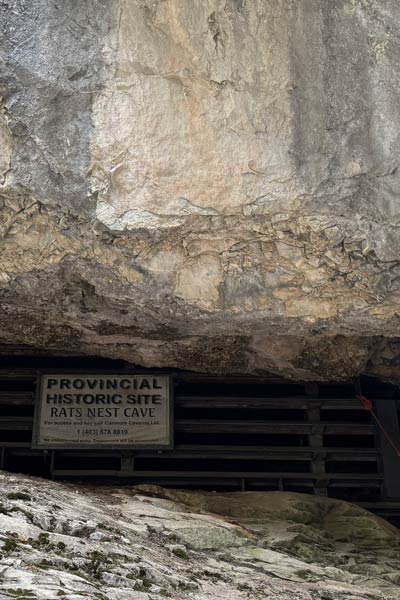
  • Entrance to Rat's Nest Cave, Canmore Alberta, showing Provincial Historic Resource sign, Graymont security gate, and faded indigenous ochre pictographs on limestone overhang — Canadian Rockies Bow Valley
    Rats Nest Cave Pictographs

    The entrance to Rat's Nest Cave as it appears today, showing the Provincial Historic Resource designation sign and the protective gate installed by Graymont Western Canada Inc. The ochre pictograph panel is visible on the limestone overhang above — barely. Centuries of weathering and vapour rising from the warm cave below have faded the markings to near-invisibility under normal light. Digital enhancement using DStretch software (see above) reveals what the naked eye can no longer easily discern.

Modern Exploration of Rat's Nest Cave

The modern chapter of the cave's story begins in the early 1970s, when rumours among mountain climbers in the Banff and Canmore area spoke of a cave on Grotto Mountain — then sometimes called 'Grotto Cave,' a name still occasionally used. The Alberta Speleological Society (ASS), active since the early 1960s, investigated the rumours and made the first serious exploratory forays into the system.

Those early trips, led in part by figures including Alfie Cawthorpe and John Donovan, mapped the main tour-side passages: the entrance, the large boulder-floored chamber below the entrance shaft, the moonmilk-coated pitch, and the routes connecting toward the Grand Gallery. The cave seemed to promise more, and it delivered. Subsequent expeditions pushed through increasingly technical terrain — through the infamous Laundry Chute, a body-sized constricted tube requiring full commitment to enter; along the Hosepipe Passage, a flat-out crawl through water; and through the Birth Canal, a squeeze leading to previously uncharted sections.

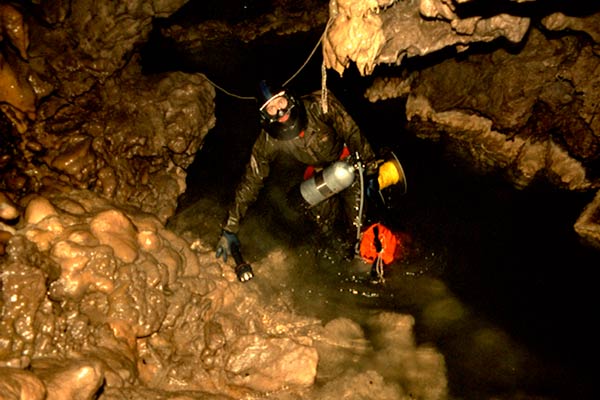
In 1979, attention turned to the flooded siphon at the Grotto — a section where the passage dips below water. Cave diver Paul Hadfield made the first successful crossing of this submerged section, entering 5°C water in full scuba gear and surfacing on the far side after a technically demanding 15-metre dive. Later expeditions pushed through a second, more constricted sump of 18 metres, finding large rounded passages beyond trending downward into unexplored territory.

Exploration continued through the 1980s and into the 2000s. The discovery of the Wedding Cake Passage — named for a distinctive stalagmite formation — led to the breakthrough that connected previously separate sections of the system. New passages were found beyond the Grand Gallery, and climbs were established into dome-like sections of ceiling passage following the fault line deeper into the mountain. By 2012, the cave had been documented to more than 4 kilometres in length, and with numerous unexplored leads still identified, the full extent of the system almost certainly remains unknown.

Rat's Nest Cave is unique among Rockies caves for its accessibility — less than 2 kilometres of hiking from the trailhead, a modest 180 metres of elevation gain — and for its relative warmth and structural stability. Most significant caves in the Canadian Rockies require multi-day alpine approaches, vertical exposure to frost-shattered rockfall, and temperatures far below freezing. Rat's Nest, by contrast, is a cave that can be fully experienced, within a single day, by people willing to commit to the physical demands of genuine caving.

Find the idea of exploration exciting? Read about the Yorkshire Pot expedition

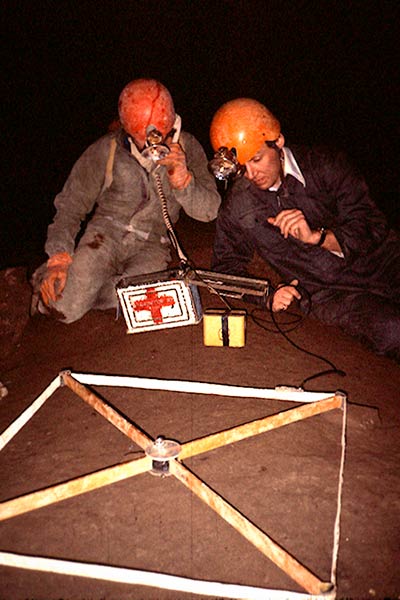
  • Cavers using cave radio survey equipment inside Rat's Nest Cave, Canmore Alberta — underground positioning technology used during exploration of the Canadian Rockies cave system
    Cave Radio

    Cavers using a cave radio during survey operations in Rat's Nest Cave. The antenna frame laid out on the cave floor transmits a signal through the rock to a receiver on the surface above, allowing surveyors underground to pinpoint their exact position within the mountain — a critical technique for building an accurate map of a complex three-dimensional cave system.

  • Caver taking survey measurements with tape measure in tight passage of Rat's Nest Cave, Canmore Alberta — underground mapping of Canadian Rockies cave system
    Cave Survey

    Taking survey measurements in a tight passage during the mapping of Rat's Nest Cave. Every metre of the cave's 4-kilometre known extent was documented this way — compass bearing, inclination, and tape measure recorded by hand in conditions that are cramped, muddy, and dark. Cave surveying is painstaking work, and the map it produces is the foundation for all subsequent scientific study of the system.

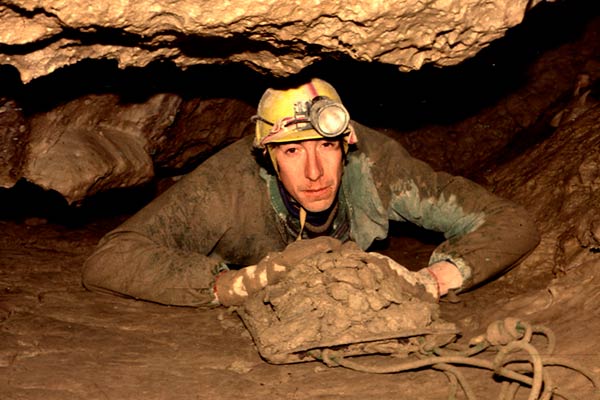
  • Explorer hauling wire ladder equipment through muddy low passage in Rat's Nest Cave, Canmore Alberta — early exploration of Canadian Rockies cave system in the 1970s
    Exploration Caving Ladders

    Hauling ladder equipment through a low, mud-floored passage in Rat's Nest Cave during an early exploration trip. Before modern rope techniques became standard, wire electron ladders were the primary means of descending the cave's vertical sections — heavy, unwieldy, and slow to rig, but the tools that made the first serious exploration of the system possible in the 1970s.

  • Caver excavating tight muddy passage during exploration dig in Rat's Nest Cave, Canmore Alberta — discovery of new passages in Canadian Rockies cave system
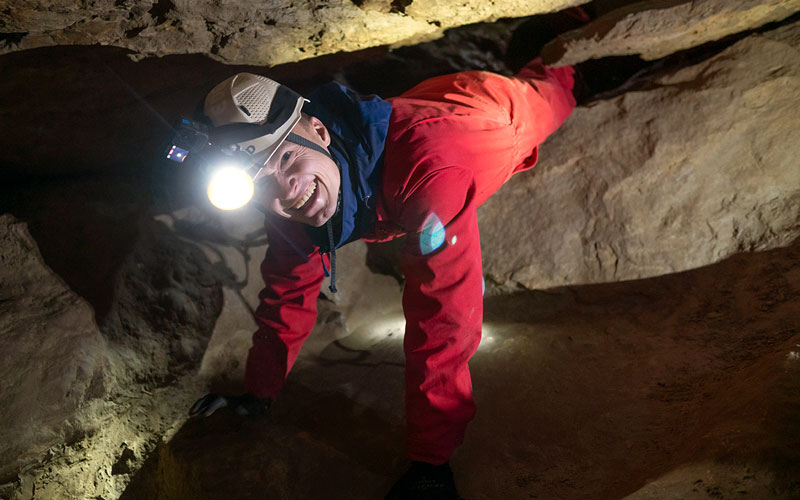
    Dig

    A caver pushing through a tight, mud-filled dig in Rat's Nest Cave. Some of the most significant discoveries in the cave's exploration history came not from open passages but from excavations like this one — the breakthrough into the Wedding Cake Passage in the late 1980s, for example, required weeks of weekend digging before the Birth Canal yielded enough space to pass through and revealed the cave extending deeper into Grotto Mountain.

  • Cave diver entering flooded siphon at the Grotto in Rat's Nest Cave, Canmore Alberta — cave diving exploration of submerged passages in Canadian Rockies cave system
    Grotto Dive

    A cave diver preparing to enter the flooded siphon at the Grotto in Rat's Nest Cave. The siphon — a section where the cave passage dips entirely below water — was first crossed in 1979 by diver Paul Hadfield, who entered 5°C water in full scuba gear and surfaced on the far side after a 15-metre dive. Subsequent expeditions pushed through a second, longer sump beyond, extending the known cave and opening new passages to exploration.
  • Caver traversing passage lined with soda straw stalactite formations in Rat's Nest Cave, Canmore Alberta — undisturbed speleothems in remote section of Canadian Rockies cave system
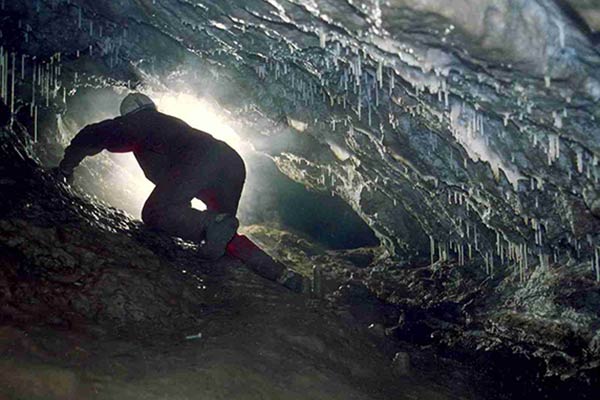
    Passage crawlway with soda straws

    A caver moving through a passage lined with soda straw stalactites in Rat's Nest Cave. The density of intact formations here speaks to how little of the cave has been disturbed — most of these passages see only occasional visits by experienced cavers. Each soda straw represents centuries of slow calcite deposition; a single careless movement can snap formations that took a thousand years to grow.

  • Caver rappelling into vertical shaft inside Rat's Nest Cave, Canmore Alberta — rope descent during exploration of Canadian Rockies cave system near Banff
    Rappel

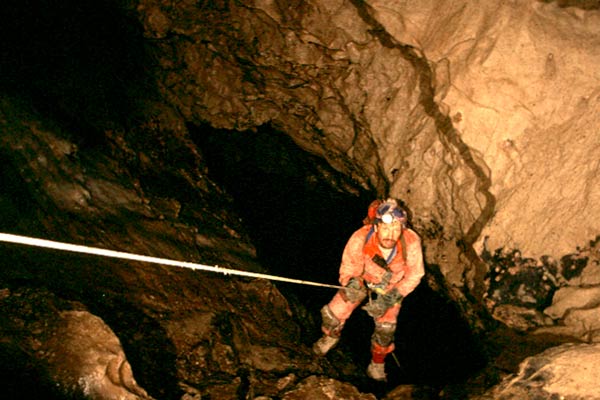
    Rappelling into one of the vertical sections of Rat's Nest Cave during an exploration trip. The cave contains several significant drops, including the 15-metre entrance shaft above the Bone Bed and a deeper pitch in the interior accessed via the cave's touring route. Rope work of this kind requires technical training and equipment — a reminder that while the cave is relatively accessible by Rockies standards, it is genuine wild caving from the moment you enter.

  • Caver recording hand-written survey notes inside Rat's Nest Cave, Canmore Alberta — underground mapping and documentation of Canadian Rockies cave system
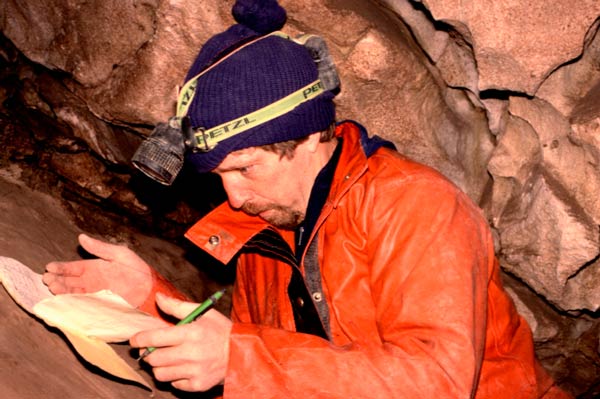
    Survey Notes

    Recording survey data by hand inside Rat's Nest Cave. Every passage, chamber, and shaft in the cave's known 4-kilometre extent exists on a map because someone sat in the dark like this — noting compass bearings, tape distances, and passage dimensions while their caving partner called out readings from ahead. The resulting survey is not only the navigation tool for the cave but the primary scientific record of its three-dimensional structure.

Provincial Historic Resource: Protection and Conservation

In March 1987, Rat's Nest Cave was formally designated a Provincial Historic Resource under Alberta's Historical Resources Act — one of very few natural cave systems in Canada to hold that status. The designation came after years of effort by cave researcher and author Charles Yonge and his partner Tonny Hansen, who lobbied the province following a systematic inventory of the cave's contents. The process was supported by grants from the Alberta Historic Resources Foundation and the Alberta Environmental Trust, and the scientific findings — particularly from Dr. James Burns' paleontological assessment of the Bone Bed — made a compelling case for protection. The designation covers a square-mile area around the cave entrance.

The designation matters for a specific reason: the cave entrance sits within an industrial lease held by Graymont Western Canada Inc., the limestone quarrying company that operates on Grotto Mountain. Graymont's quarry — visible as a prominent scar on the mountain's flank when viewed from Canmore — is located approximately 1.5 kilometres from the cave entrance. As the leaseholders, Graymont serves as site custodians under the historic designation. The protection status, combined with a negotiated management agreement and a permit from Alberta Sustainable Development, established the framework under which guided access to the cave is possible today.
The relationship between industrial land use and cave conservation is an unusual one, but it has proven workable. Graymont's primary concern was liability — quarry blasting occurs several times a year on the mountain — and an independent consultant assessed that blasting at that distance poses no meaningful risk to the cave's interior or its formations. That assessment cleared the way for a formal access and management agreement. Over more than three decades of guided operations, no blasting-related incidents have occurred at the cave. Graymont also funded the installation of a specially designed gate at the cave entrance — built with spacing that allows bats and wood rats to pass freely — which prevents unmanaged access while preserving the cave's ecological function.

The Provincial Historic Resource designation carries real teeth. It protects the cave's geological features, its speleothems, its sediment stratigraphy, its paleontological and archaeological material, and its living ecosystem from disturbance or removal. The Historical Resources Act makes damage to a designated site a legal offence. Combined with active on-site management, this framework has kept the cave in substantially better condition than many comparable sites, where uncontrolled access has resulted in broken formations, disturbed bone deposits, and graffiti. The designation is not merely a plaque on a wall — it is the legal and institutional structure that makes responsible access to the cave possible at all.

Frequently Asked Questions About Rat's Nest Cave

  • Where is Rat's Nest Cave located?

    Rat's Nest Cave is located beneath Grotto Mountain near Canmore, Alberta, in the Bow Valley of the Canadian Rockies. It is approximately 10 minutes east of the town of Canmore, 25 minutes from Banff, and sits at the western edge of Kananaskis Country. The cave entrance is accessible via a short hike of less than 2 kilometres from the trailhead, gaining approximately 180 metres in elevation. The Trans-Canada Highway (Highway 1) runs through the Bow Valley below, making the cave one of the most accessible significant cave systems in the Canadian Rockies.

  • How long is Rat's Nest Cave?

    The known extent of Rat's Nest Cave is more than 4 kilometres of mapped passage, making it one of the longer cave systems in Alberta. The cave is a three-dimensional maze of passages, chambers, tubes, and shafts. Its full extent is not yet known — as of 2012, numerous unexplored leads had been identified, and further passages are likely still to be discovered within Grotto Mountain.

  • How old is Rat's Nest Cave?

    The limestone rock in which the cave formed originated as tropical coral reef deposits approximately 320 to 360 million years ago during the Devonian and early Carboniferous periods. The cave itself began forming after the Canadian Rocky Mountains were built, roughly 45 to 85 million years ago, as groundwater began to dissolve the faulted limestone. Speleothem (mineral formation) deposits within the cave have been dated to as old as 766,000 years before present using uranium-series dating, providing a climate record spanning the majority of the Pleistocene ice ages. Human presence at the cave has been documented to at least 3,000 years ago.

  • Is Rat's Nest Cave protected?

    Yes. Rat's Nest Cave was designated a Provincial Historic Resource under Alberta's Historical Resources Act in March 1987 — one of very few natural cave systems in Canada to hold this status. The designation covers a square-mile area around the cave entrance and legally protects the cave's geological features, speleothems, paleontological and archaeological material, and living ecosystem. The cave entrance is located within a lease held by Graymont Western Canada Inc., the limestone quarrying company that operates on Grotto Mountain, which serves as site custodian under the historic designation. A management agreement between the province, Graymont, and the cave operators governs all access to the site.

  • What animals live in Rat's Nest Cave?

    The cave supports a variety of wildlife year-round. The most visible residents are bushy-tailed wood rats (pack rats), whose middens are found on ledges throughout the entrance area, and occasional little brown bats, which use the cave as a hibernaculum. The stable above-freezing temperature makes the cave an important winter refuge for insects including mosquitoes, gnats, harvestmen (daddy-long-legs), crickets, and beetles. Researchers have also identified asellid isopods (a type of small crustacean, Salmasellus steganothrix) living in the cave's water features — organisms that are adapted to subterranean aquatic environments. The cave's Bone Bed records the remains of 34 mammal species that have inhabited the Bow Valley over the past 7,000 years, including gray wolf, black bear, lynx, wolverine, coyote, and the now-locally-extinct swift fox.

  • Is Rat's Nest Cave near Banff?

    Yes. Rat's Nest Cave is located approximately 25 kilometres east of the town of Banff, or roughly a 20-25 minute drive along the Trans-Canada Highway. It sits just outside Canmore, which borders Banff National Park to the east. While the cave itself is not within the national park boundaries, it is part of the same mountain landscape — formed in the same Carboniferous limestone, shaped by the same glacial history, and set within the broader Bow Valley corridor that connects Banff, Canmore, and the gateway to Kananaskis Country.

  • What makes Rat's Nest Cave scientifically significant?

    Rat's Nest Cave is considered one of the most scientifically significant cave systems in Canada for several overlapping reasons. Its speleothems (mineral formations) provide a climate record extending back approximately 766,000 years — among the most complete Quaternary records from any cave in the country. The cave's Bone Bed is potentially the best-documented mid- to late-Holocene vertebrate fossil site in Alberta, with 34 identified mammal species spanning 7,000 years. Its archaeological material provides evidence of indigenous use dating back at least 3,000 years. And research conducted at the cave contributed to internationally recognized advances in speleothem climate science, including the identification of annual solar cycles preserved in cave mineral layers (Shopov Bands). The cave's Provincial Historic Resource designation reflects this accumulated scientific value.

A Place That Has Always Mattered

What makes Rat's Nest Cave extraordinary is not any single feature, but the convergence of so many. It is a geological archive spanning hundreds of millions of years — from tropical Carboniferous reef to glacially-carved mountain. It is a climate laboratory whose speleothems hold a nearly three-quarter-million-year record of regional temperature and precipitation. It is a wildlife repository containing the bones of animals that have not been seen in this valley for centuries. It is an archaeological site where people processed meat, discarded tools, and possibly performed ceremonies thousands of years before Europeans arrived in the Rockies.

Alberta recognized this convergence in 1987, when the cave received its Provincial Historic Resource designation — a status it retains to this day. The designation reflects not only the age of what lies inside, but the irreplaceability of it. Every formation broken, every sediment layer disturbed, every bone displaced is a page torn from a book that took millions of years to write.

The cave is still here. The fault that started everything is still there in the rock. The stalactites are still growing, one infinitesimal layer at a time, adding to a record that will eventually be read by scientists we cannot yet imagine. Grotto Mountain still stands over the Bow Valley, keeping its cave in the dark.

Experience Rat's Nest Cave for Yourself

Rat's Nest Cave is open for guided tours year-round, departing from Canmore — less than 25 minutes from Banff. Two tour options are available: the Explorer Tour spends 2.5 hours underground passing ancient bones and cave formations, while the Adventure Tour adds an 18-metre rappel and a full 4 hours beneath the mountain. Tours are available to ages 10 and up (Explorer)/12 and up (Adventure), and all equipment is provided. No caving experience is required — only a moderate level of fitness and a sense of adventure.

Reliably Warm & Consistently Cool

HOW CAVES MAINTAIN THEIR CONSTANT TEMPERATURES YEAR-ROUND


How is it that even on the coldest days of the year a dark hole in the side of Grotto Mountain maintains a modicum of warmth while the rest of the countryside succumbs to the long, deep freeze?

There is something a little bit odd - disconcerting even - about standing at the entrance of Rat’s Nest Cave on a cold winter day and feeling warm air pouring out of the cave. That can’t be natural, can it? Caves are supposed to be damp and cold, aren’t they?

Rat’s Nest Cave is not really “warm,” per se. Its roughly 4.5℃ temperature is constant year-round, making it feel rather balmy compared to the frosty temps of winter, but it’s really still the same temperature as your refrigerator. This quality is not unique to Rat’s Nest Cave, but it is a quality that humanity has been exploiting for thousands of years.

Most naturally occurring caves will maintain a relatively constant temperature throughout the year so long as it extends far enough into the rock to escape the influence of the entrance air temperatures. This distance can be as little as 10 meters in some caves so the temperature change can be quite dramatic, as is the case in Rat’s Nest Cave. You probably wouldn’t describe a cave as “cozy”, but it’s easy to see how our early ancestors would find sheltering in caves appealing.

Rat's Nest Cave in the Summer
Rat's Nest Cave in the Winter
Move the slider to see how the cave changes through the year...

WHY/HOW DOES THE CAVE MAINTAIN THE SAME TEMPERATURE YEAR ROUND?

Why doesn’t the cave’s temperature change daily, or with the seasons like it does outside?

A cave’s temperature is generally equal to the average temperature of the surrounding area, meaning that caves in different parts of the world, at different elevations, will have different temperatures. A cave receives its temperature from a number of “inputs” including air and water flow, as well as direct transmission through the rock walls of the cave, but this is an incredibly slow process.

Rock has a very high thermal mass (this is the rock’s ability to absorb and store heat energy) and it acts like a big blanket the prevents the cave from absorbing or giving away heat. Rat’s Nest Cave is literally inside a mountain, so there is a whole lot of rock between the cave and the outside air. It takes either a lot of temperature difference, a lot of time, or both to influence the temperature of the cave which is why changes in the cave usually occur over hundreds or thousands of years.

Latest Posts

A BIG, BOOMING EXCEPTION…

So we say that a cave’s temperature is “generally” based on the average temperature of the surrounding area. Why? Because there’s always a cave that just can’t follow the rules. Actually, there are quite a few of them.

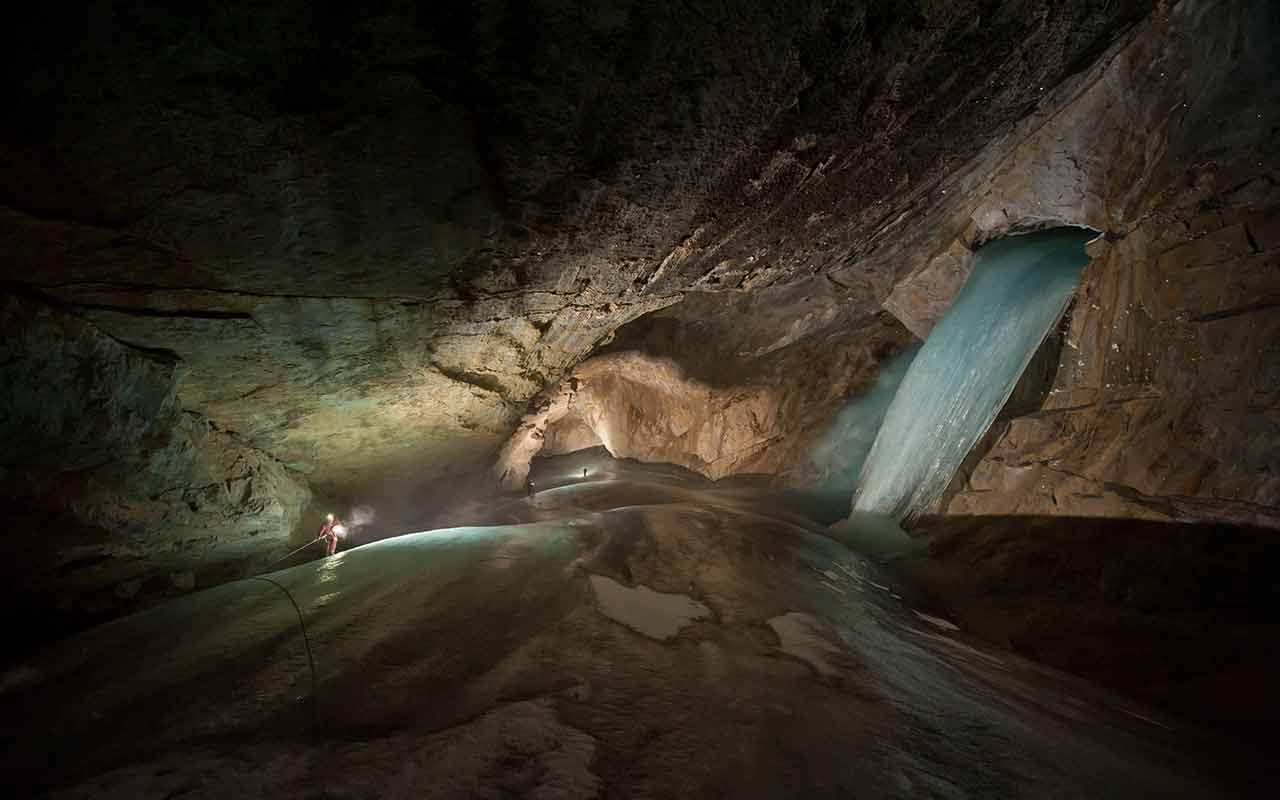
For example, the Booming Ice Chasm, which was originally explored in 2008, is referred to as a cold-trap cave because, due to its position in the mountain, its shape, and its overall circumstances, it traps cold air year-round and maintains a temperature of just below freezing. This is decidedly lower than the surrounding area’s average temperature.

The entrance to the Booming Ice Chasm is situated high up on the side of a mountain and the cave dips steeply down, descending over 170 meters into the mountain. Throughout the winter cold air will sink down into the cave where, unlike Rat’s Nest Cave with it’s many breathing holes, it appears that in the BIC the cold air has nowhere to go. This has resulted in the cave hosting a massive amount of permanent ice year-round, making for some pretty incredible images. When the cave was first discovered stones were tossed into the gaping entrance to get a sense of just how deep the cave was. The “booming” echos the cavers received in reply indicated they hadn’t brought enough rope.

The Booming Ice Chasm in all its glory.

IT’S ALIVE! WELL, IT BREATHES…

Sometimes it can feel colder in some parts of the Rat’s Nest Cave than others. This can be the result of air flow, or “breathing,” that occurs in parts of the cave because of a temperature or pressure difference.

Even though Rat’s Nest Cave only has one known entrance, we are quite confident that there are other smaller holes that allow air to enter or escape and these holes are likely present at different elevations. Cold winter air entering a lower hole might warm and rise through the cave to exit higher up, drawing more air in - while in the summer warm air can cool and sink down through the cave. High and low pressure systems can also influence the flow of air into and out of the cave.

CAVES: THE SILENT RECORD KEEPERS

This predictably slow change in temperature means that caves are an incredible repository of historical temperature data. In theory, if you travel to a part of a cave deep inside a mountain that has minimal air and water flow, the temperature you are feeling could actually be thousands of years old as the cave has not yet adjusted to modern temperatures.

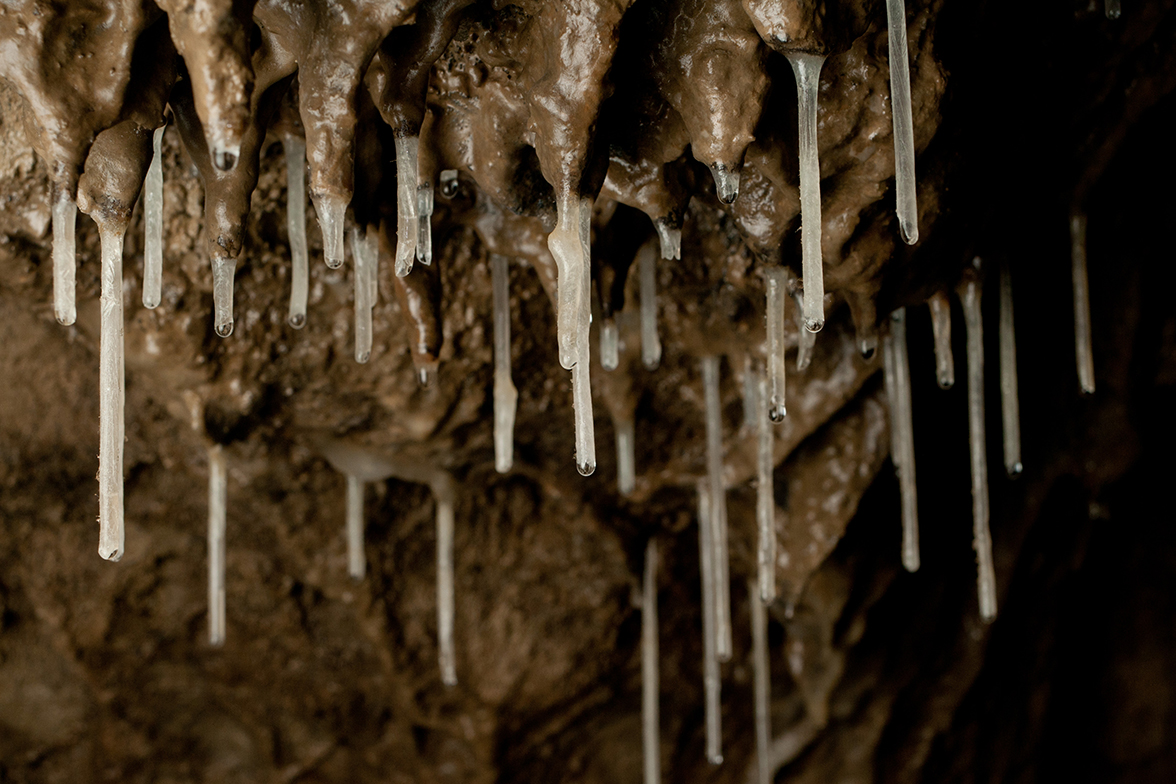
Soda-straw stalactites hanging in the Grotto.

SPELEO-WHAT?

Caves offer even more interesting ways to measure past climate information, and they come in the form of beautiful mineral decorations collectively known as speleothems.

You are most likely familiar with the speleothems known as stalactites and stalagmites. These are two of many types of cave formations created as a result of the mineral calcite being deposited by drip water as it runs down the walls of caves. Stalactites, stalagmites, and all of the other speleothems have become some of the most important sources of climate data in the discussion around climate change due to their global ubiquitousness (caves are everywhere in the world) and their unique ability to store information over long periods of time.

The way these beautiful little formations store information is fascinating, and temperature is just one of the stories that is captured. For example, due to the fact that speleothems form from the flow of water we know that if the surface temperature is cold enough to prevent water from entering the cave these formations will stop growing. We can see these cold events (aka glaciations) in the speleothem record.

As water travels down from the surface and into the cave it is bringing organic chemicals along with it. These organics are trapped in the calcite mineral, and because these organics are only available when plants are growing we can track the seasonal growth of plants. We can even see sun activity oscillations in the deposition of certain chemicals.

The most promising feature of these formations is their propensity for trapping gasses in the minerals during the formation process. Some of the oldest formations in Rats Nest Cave are over 750,000 years old meaning that we have gases trapped in formations that are that old as well. This gives us the ability to directly compare those gases with their modern counterparts, providing insights into those past climates. Enthralling stuff!


YOU'RE IN-THE-KNOW

Now you know that (most) natural caves maintain their temperatures year round, why that is, and why it’s important. On top of that, you now know that you can explore Rats Nest Cave at a comfortable temperature any day of the year. Why save all the fun for summer? Join us for a tour this winter!

Wild Caves vs. Show Caves

Wild Caves vs. Show Caves: Understanding Two Very Different Underground Experiences

For many people, their first curiosity about caves starts the same way: What is it actually like down there? Darkness, stone, stillness, maybe a hint of mystery.

What often comes as a surprise is that not all cave experiences are the same. Around the world, caves are accessed and interpreted in very different ways, depending on their geology, conservation needs, and history of human use. Two of the most common categories you’ll hear are show caves and wild caves. This isn’t a competition between the two. Both have value. Both play an important role in education, conservation, and access. But they offer very different ways of interacting with the underground world — and understanding that difference helps set better expectations before stepping below the surface.

  • San Doong Cave, China

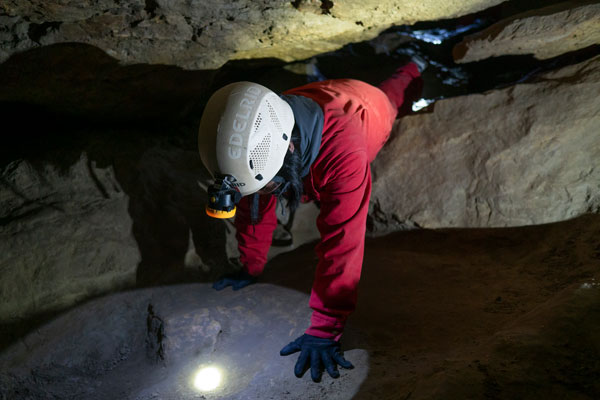
  • Rats Nest Cave, Alberta

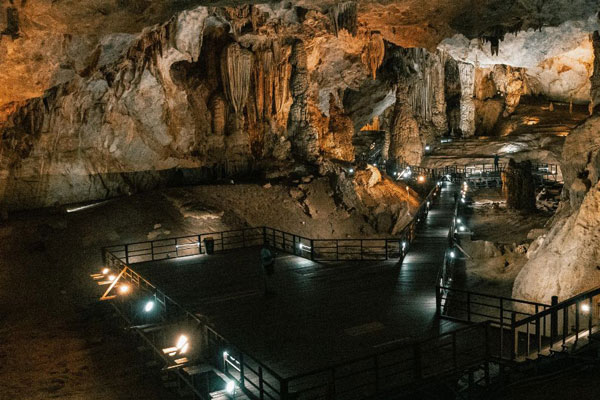
  • Luray Caverns, Virginia

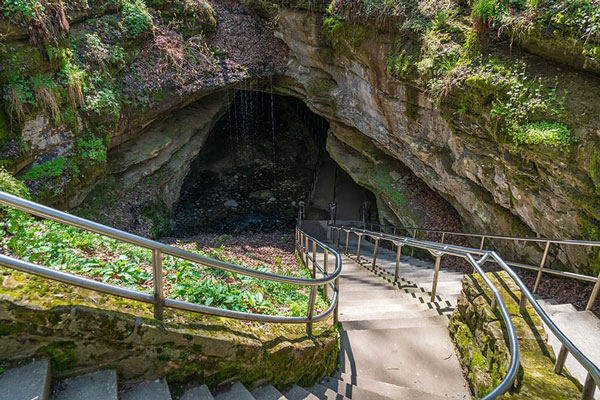
  • Mammoth Caves, Kentucky

  • Sterkfontein Caves, South Africa

  • Rats Nest Cave, Alberta

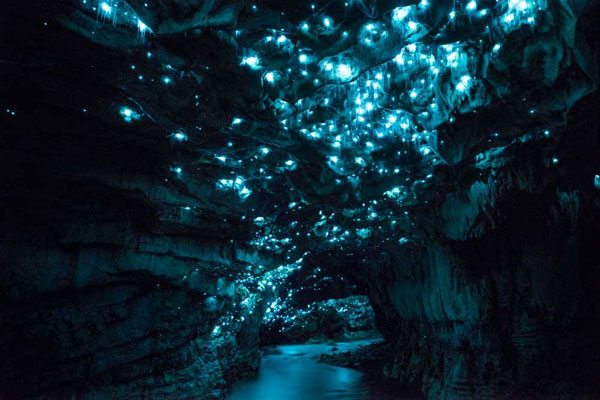
  • Waitomo Cave, New Zealand

  • Manjanggul Cave, South Korea

Two paths underground

At a high level, the difference between show caves and wild caves comes down to how humans interact with the cave environment.

Show caves are developed to allow large numbers of people to safely visit sensitive underground spaces with minimal training. Wild caves, by contrast, are kept as close to their natural state as possible, with minimal infrastructure and a strong emphasis on conservation, skills, and personal responsibility.

Both approaches exist because caves themselves are incredibly fragile — shaped over hundreds of thousands to millions of years, yet easily damaged in moments.

Show caves: access, interpretation, and preservation through infrastructure

Show caves are often the first underground experience people ever have — and for good reason.

They typically include:

  • Installed lighting systems
  • Constructed walkways, staircases, and railings
  • Designated routes that visitors must stay on
  • Guided interpretation focused on geology, history, and formations

The infrastructure fundamentally shapes the experience. Visitors move through the cave rather than within it. The pace is steady, the environment predictable, and the physical demands relatively low.

This approach has real benefits:

  • It allows a wide range of visitors to safely experience caves
  • It concentrates foot traffic onto hardened paths
  • It protects sensitive areas from direct contact
  • It makes interpretation accessible and consistent

In show caves, conservation is achieved largely through controlled movement. You don’t touch formations. You don’t leave the path. The cave is presented as something to observe rather than navigate.

For many people, this is exactly the right introduction — a chance to see underground landscapes that would otherwise be inaccessible.

Wild caves: minimal impact, maximum responsibility

Wild caves take a very different approach.

In a wild cave, the priority is preserving the cave’s natural state. That means:

  • No installed lighting
  • No constructed walkways
  • No railings or staircases
  • Minimal permanent modification, if any

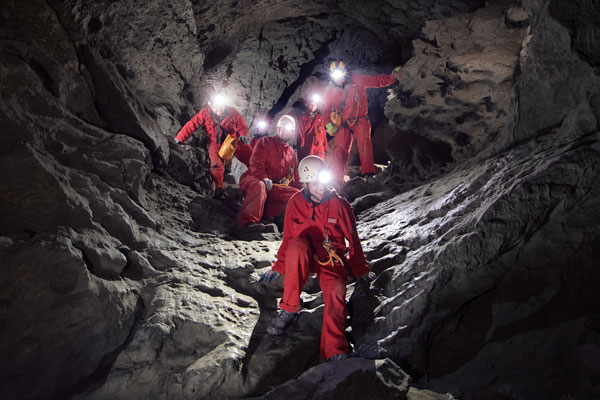
Movement through a wild cave is dictated by the cave itself — uneven floors, tight passages, vertical drops, and natural obstacles. Visitors must actively engage with the environment, often using helmets, headlamps, harnesses, and rope systems.

Rather than being passive observers, participants become part of the cave’s story, making decisions about where to step, how to move, and how to minimize impact.

Because of this, wild caves require:

  • Smaller group sizes
  • Specialized training or guiding
  • Strong conservation ethics
  • A slower, more deliberate pace

The experience is immersive, physical, and often deeply memorable — but it also demands respect. In wild caves, conservation isn’t enforced by infrastructure; it’s upheld by behavior.

How the experience feels different

One of the clearest distinctions between show caves and wild caves is how they feel to be in.

In show caves:

  • Lighting defines what you see
  • Sound is often amplified by open chambers
  • The route is fixed
  • The experience is largely observational

In wild caves:

  • Darkness is complete without your headlamp
  • Silence is more profound
  • Movement is intentional and varied
  • The cave reveals itself gradually

Neither experience is inherently better — but they serve different purposes.

Show caves excel at broad education and accessibility. Wild caves excel at fostering a deeper, more personal connection to the underground environment.

Conservation: shared goals, different methods

Caves are non-renewable environments on a human timescale. Once damaged, many features will not recover.

Show caves and wild caves both aim to protect these spaces, but they do so differently.

Show caves rely on:

  • Physical barriers
  • Controlled lighting
  • Defined visitor routes

Wild caves rely on:

  • Education and training
  • Low-impact techniques
  • Strict group management
  • Ongoing monitoring

In both cases, conservation is the foundation — not an afterthought. The methods simply reflect different philosophies of access.

Where Rat’s Nest Cave fits in

Rat’s Nest Cave, located near Canmore, Alberta, is considered a wild cave.

It has no installed lighting or walkways, and its formations, passages, and features remain largely in their natural state. Access is carefully managed, and tours are designed to balance exploration with preservation.

Guided trips through Rat’s Nest focus on:

  • Small group sizes
  • Proper equipment and techniques
  • Education about cave geology and conservation
  • Respectful movement through the cave

For visitors, this means the experience feels more exploratory than theatrical. You’re not walking through a lit corridor — you’re moving through a living geological system, learning how to travel responsibly in a fragile environment.

Understanding the difference between wild and show caves helps clarify what kind of experience Rat’s Nest offers, and why it’s approached the way it is.

Choosing the right underground experience

Show caves and wild caves aren’t opposing ideas. They’re complementary.

Show caves introduce people to underground landscapes in a safe, accessible way. Wild caves offer deeper immersion for those ready to take on more responsibility and adventure.

Knowing the difference allows visitors to choose experiences that align with their comfort level, curiosity, and values — and to better appreciate the care required to protect these extraordinary places.

For those interested in learning more about the history, exploration, and significance of Rat’s Nest Cave specifically, Under Grotto Mountain by Charles J. Yonge offers a detailed and thoughtful look at the cave and its exploration history.

Whether your curiosity starts with a lit pathway or a headlamp beam cutting through darkness, the underground world has a way of leaving a lasting impression — especially when approached with understanding and respect.

Latest Articles